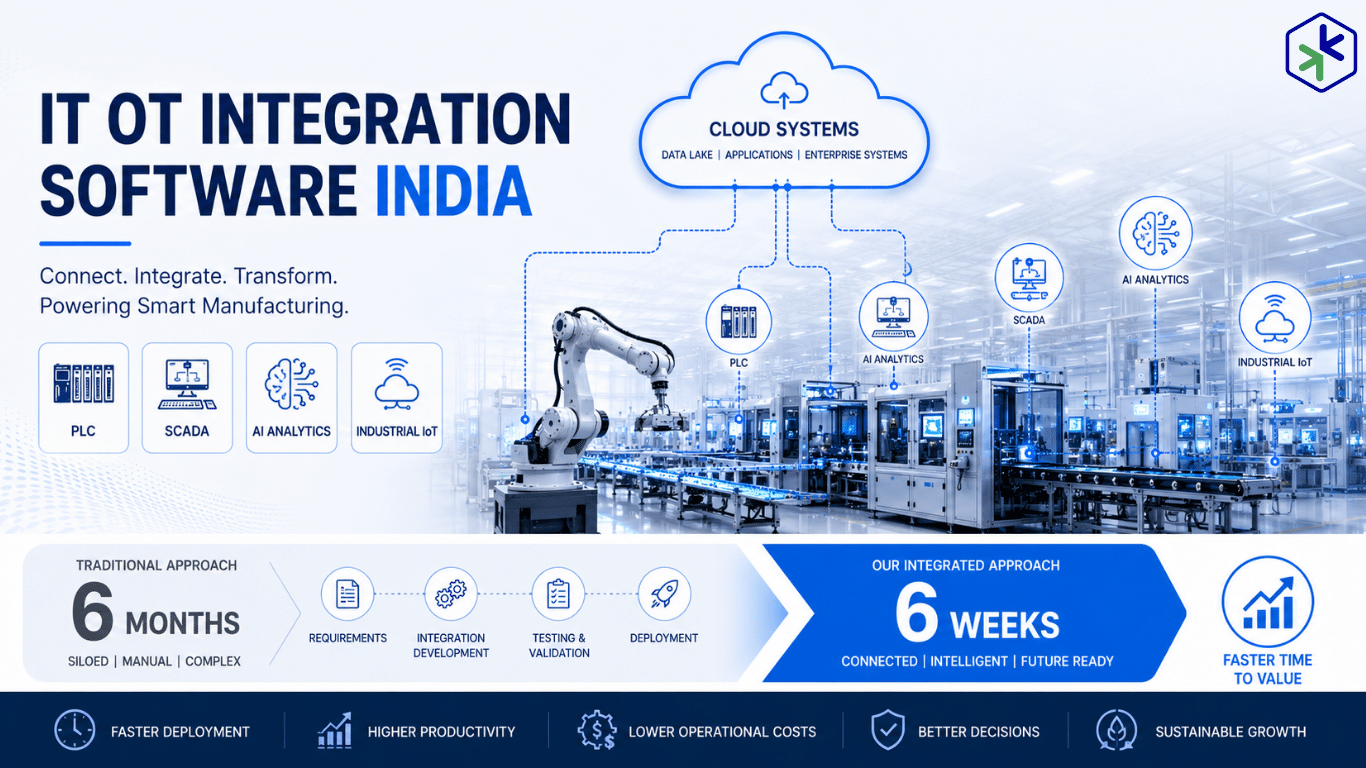
From 6 Months to 6 Weeks : How No-Code Platforms Are Accelerating IT OT Integration in Indian Manufacturing
Written by Ketsol Manufacturing Suite
Industrial Data & AI Practitioners | OT/IT Convergence Specialists.
Ketsol is an industrial technology firm specialising in data infrastructure for manufacturing environments. With over 15 years of experience across discrete and process industries, the team has delivered large-scale data architecture and IIoT implementations, including work with Tier-1 manufacturers.
Core expertise includes Unified Namespace (UNS) architecture, industrial data modelling, and AI readiness for production systems. Ketsol combines deep operational understanding with modern data engineering practices to bridge the gap between OT and enterprise systems.
Published: May 2026
Most industrial digitalisation projects in India take far longer than planned. What begins as a six-month implementation often stretches to a year, burning budgets, delaying ROI, and frustrating plant teams. The root cause is rarely the technology. It is how projects are structured, deployed, and managed.
Today, a new approach is gaining traction. No-code and low-code platforms are helping manufacturers go live in six weeks not six months. They reduce coding dependency, simplify IT OT integration software India initiatives, and give plant teams the tools to move faster without sacrificing control.
Here is what is changing, why traditional projects struggle, and how your team can avoid the same mistakes.
What Is IT OT Integration and Why Does It Matter for Manufacturing?
IT OT integration connects your enterprise Information Technology systems with the Operational Technology running your factory floor.
In practice, this means linking:
- PLCs and SCADA systems
- Sensors and edge devices
- MES and ERP platforms
- Cloud analytics tools
The goal is a single, unified flow of real-time industrial data. When IT and OT systems work together, production teams, maintenance engineers, and business leaders make decisions from a single source of truth, not from disconnected spreadsheets and siloed reports.
This is the foundation of IT OT convergence, and it is quickly becoming a competitive requirement for manufacturers in India.
Why Do Traditional IT OT Integration Projects Take So Long?
Delays are usually caused by three compounding problems:
1. Mixed Protocols and Legacy Systems
Most plants were not built in one shot. They have machines from different eras, different PLC brands, and multiple communication protocols: Modbus, OPC UA, MQTT, and proprietary formats.
Each connection requires separate mapping, custom middleware, or protocol translation. On a large plant, this alone can consume weeks of engineering effort.
2. Moving Targets During Implementation
Manufacturing environments do not pause for IT projects. During implementation, production priorities shift. New lines are added. Machines are reconfigured.
Requirements change midway. Dashboards need redesigning. Data structures become inconsistent. These moving targets are among the biggest challenges manufacturers face in IT-OT integration today.
3. Over-Reliance on External Experts
Traditional projects depend heavily on system integrators and automation consultants. Internal teams often cannot make even minor changes without vendor support.
Every update triggers an approval cycle. Innovation slows. Costs compound. The plant team ends up managing a system they do not fully own.
Why Do IT OT Integration Projects Fail?
Many manufacturers invest significantly in industrial digitalisation and still fail to see measurable outcomes. The reasons are almost always the same.
1. Poor Data Structure
Factories collect enormous volumes of machine data. But without proper tagging and hierarchy
Plant > Area > Line > Machine > Parameter
when that data becomes noise. Dashboards lose reliability. AI initiatives fail before they start.
2. IT and OT Teams Working in Silos
IT teams prioritise security, scalability, and infrastructure. OT teams prioritise uptime, machine reliability, and production continuity. Without active collaboration, integration projects get built in isolation and become disconnected from operational reality the moment they go live.
3. Over-Customisation
Building every workflow from scratch increases development time, maintenance complexity, and future upgrade difficulty. One of the most common IT OT integration mistakes is assuming that every use case requires custom engineering. It rarely does.
4. Low User Adoption
If operators and plant engineers do not trust the system, dashboards go unused. Alerts get ignored. Data-driven decisions never happen. Technology alone does not create transformation; people do.
How Do No-Code Platforms Change Industrial Data Integration?
No-code does mean no logic. It means less programming dependency.
With modern no-code platforms, plant and IT teams can:
- Connect PLCs, SCADA systems, and sensors using pre-built connectors
- Configure industrial workflows visually without writing custom code
- Build OEE dashboards, downtime monitors, and energy reports quickly
- Modify and iterate on configurations without vendor involvement
This makes industrial data integration faster, more affordable, and accessible to mid-sized manufacturers and MSMEs not just large enterprises with dedicated IT departments.
For manufacturers evaluating IT OT integration software in India, the no-code model significantly reduces the barrier to entry.
What Does a Faster Deployment Actually Look Like?
A structured six-week deployment model using no-code tools typically follows this sequence:
- Week 1: Connect PLCs, SCADA systems, sensors, OPC UA devices, and MQTT brokers using pre-built connectors. Minimal custom engineering required.
- Weeks 2–3: Organise raw machine data into clear operational hierarchies. This structured layer is what enables reliable analytics and future AI applications.
- Week 4: Build production dashboards, OEE monitoring, downtime tracking, energy usage, and quality reports directly from structured data.
- Weeks 5–6: Validate data accuracy, fine-tune workflows, train operators, and verify KPIs before going live.
Unlike traditional deployments, no-code platforms allow continuous improvement after go-live. Teams do not have to wait for the next project cycle to make changes.
What Are the Real Business Benefits of IT OT Convergence?
When IT OT convergence is done well, the operational impact is measurable:
- Faster access to production insights from days to minutes
- Reduced downtime through real-time monitoring and early alerts
- Better energy efficiency tracking across equipment and shifts
- Improved cross-functional decision-making between production and management
- Scalable digitalisation starts with one line, expands across the plant
- Stronger foundation for predictive maintenance and AI-driven analytics
Most importantly, faster deployment means faster operational learning. The sooner your team works with live data, the sooner they can act on it.
Key Insights for Manufacturing Leaders
1. Long deployment timelines are caused by process inefficiencies, not technology limitations
2. Mixed protocols and legacy infrastructure are the primary source of industrial data integration complexity
3. Most IT OT integration projects fail due to poor data structure, siloed teams, and low adoption, not budget
4. No-code platforms reduce coding dependency and make digitalisation accessible to smaller manufacturing teams
5. Structured data is a prerequisite for reliable analytics and future AI applications
6. Successful IT OT convergence requires active collaboration between production, maintenance, and IT teams
7. Phased deployment, starting small and scaling consistently, outperforms large, complex rollouts
Conclusion
- Manufacturing digitalisation is no longer about installing software. It is about building connected, adaptable, data-driven operations faster than your competitors.
- The shift from custom-coded implementations to configurable no-code platforms is changing how IT OT integration in manufacturing plants gets done across India. Deployment timelines are compressing. Internal teams are gaining more ownership. And the gap between data collection and operational action is closing.
- If your organisation is evaluating industrial digitalisation options, start by identifying where disconnected data is slowing decisions. That is almost always the best place to begin and the fastest path to visible results.
- Want to see how a structured IT OT integration approach could work for your plant? Explore our Industrial IoT solutions page to learn what a phased deployment could look like for your facility.
Talk to the engineers who commissioned these plants →https://ketsol.ai/about
FAQ:
- What is IT OT integration in manufacturing?
IT OT integration connects enterprise IT systems — such as ERP and analytics platforms — with operational factory systems like PLCs, SCADA, MES, and sensors. The goal is real-time data visibility and faster operational decision-making.
2. Why do IT OT integration projects fail?
The most common reasons are poor data structure, lack of collaboration between IT and OT teams, over-customisation, and low adoption by plant users. Technology is rarely the primary cause of failure.
3. What are the biggest IT OT integration challenges?
Protocol compatibility across legacy systems, changing production environments during implementation, data standardisation, cybersecurity concerns, and dependency on external vendors are the most frequently cited challenges.
4. How do no-code platforms help with industrial data integration?
No-code platforms reduce development complexity by allowing teams to configure integrations and dashboards visually — without writing extensive custom code. This shortens deployment timelines and reduces reliance on specialised developers.
5. What is IT OT convergence?
IT OT convergence is the alignment of information technology and operational technology systems to create connected industrial operations. It enables unified data flows, faster decisions, and the foundation for advanced applications like predictive maintenance and AI-driven analytics.
6. How long does IT OT integration typically take with no-code platforms?
Traditional custom-coded implementations often take 6–12 months. Modern no-code approaches can reduce this to 6 weeks for initial deployment, depending on plant complexity and the number of systems being integrated.
7. Is no-code IT OT integration suitable for mid-sized manufacturers in India?
Yes. No-code platforms are particularly well-suited for mid-sized manufacturers and MSMEs that need to digitalize operations without large dedicated IT teams or high integration budgets. They make Industry 4.0 adoption more accessible and cost-effective.