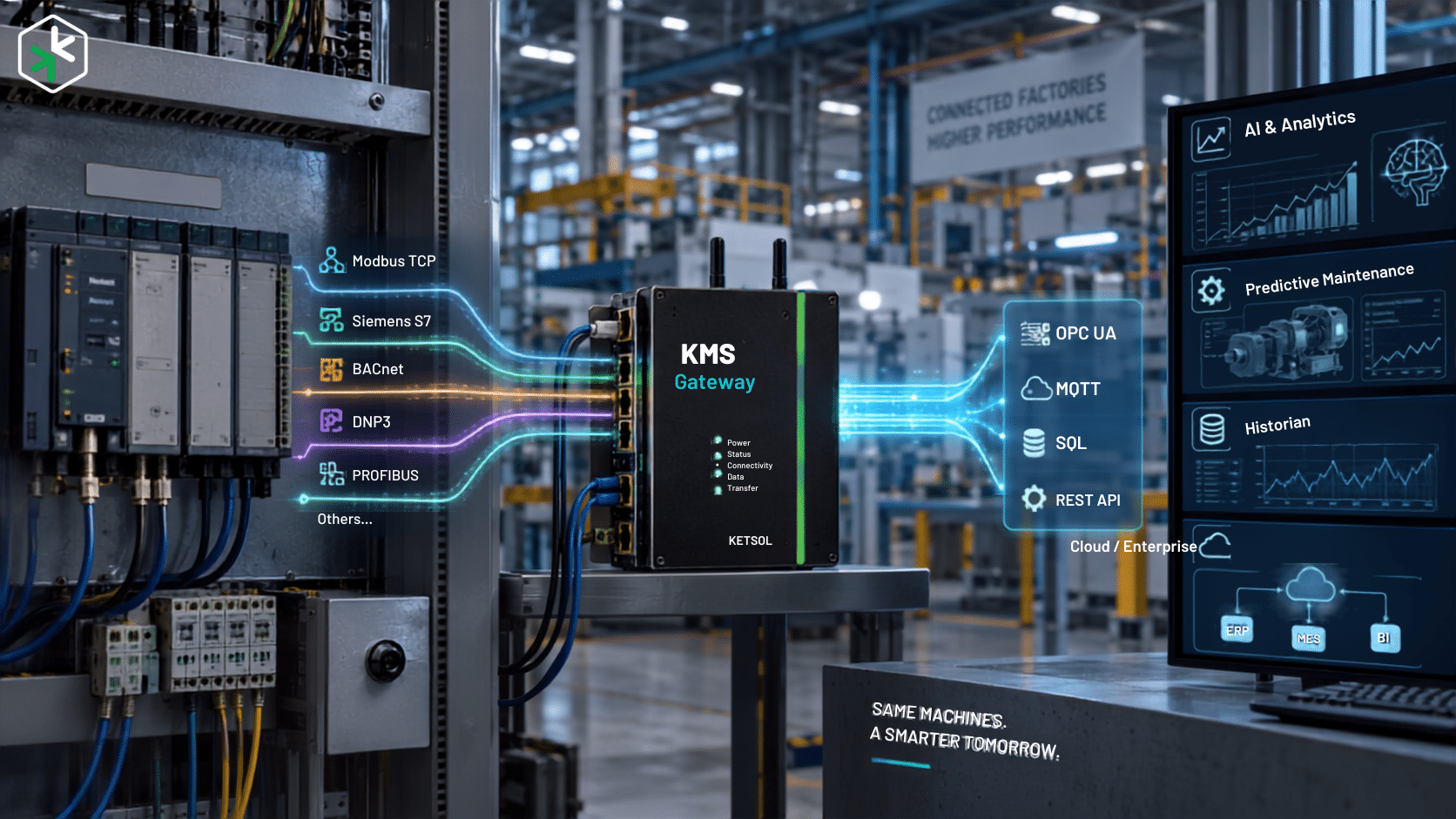
Industrial Protocol Gateway: Why Legacy PLCs Are Quietly Blocking Your AI Strategy
Written by Ketsol Manufacturing Suite
Industrial Data & AI Practitioners | OT/IT Convergence Specialists.
Ketsol is an industrial technology firm specialising in data infrastructure for manufacturing environments. With over 15 years of experience across discrete and process industries, the team has delivered large-scale data architecture and IIoT implementations, including work with Tier-1 manufacturers.
Core expertise includes Unified Namespace (UNS) architecture, industrial data modelling, and AI readiness for production systems. Ketsol combines deep operational understanding with modern data engineering practices to bridge the gap between OT and enterprise systems.
Published: Aug 2026
Walk onto most factory floors built before 2015. You will find a controller still doing the exact job it was commissioned to do decades ago: reading sensors, driving actuators, keeping a line running. It was built to talk Modbus TCP to a local HMI. It was never built to feed a machine learning model or stream data to the cloud.
Today, that same PLC is expected to do both. In most plants, it cannot, not without an industrial protocol gateway sitting between the old controller and everything that now needs its data.
This is not a small technical detail. It is often the real reason AI and IoT initiatives stall after a successful pilot.
How Old Is the Average PLC Still Running Production Today?
Older than most digital transformation plans assume. Roughly half of manufacturers are still running operational technology assets that are 15 years or older. In India, most factories run equipment that is 10 to 20 years old, installed long before connectivity was a design requirement.
This is not a handful of outdated facilities. It is the baseline condition across manufacturing. A plant’s newest CNC machine might speak OPC UA natively. The ten older PLCs feeding the same production line, running Modbus TCP, BACnet, DNP3, or a proprietary fieldbus, are what actually determine how much usable data reaches your systems.
Why Do Legacy PLCs Become an AI and Analytics Problem?
Because AI is only as good as the data it receives, and legacy PLC data integration is where most of that data quality gets lost.
As of 2026, 42% of manufacturers have deployed AI in some form. Only 12% have scaled past a single pilot to enterprise-wide use. That gap almost always comes down to the same root cause. AI models need OT data flowing reliably. Getting there requires real manufacturing connectivity, not just a working pilot on five machines.
Picture a decade-old PLC reporting temperature and cycle time over a serial connection, with no timestamp sync and no semantic context. A predictive maintenance model built on that data is working with a fraction of the real picture. The AI conversation gets the attention. The protocol layer underneath it gets ignored, until it becomes the bottleneck.
Where Does This Show Up in Day-to-Day Operations?
It rarely appears as one dramatic failure. It shows up as a series of small, compounding costs:
- Integration overhead per protocol. Every additional fieldbus format on the floor, from Modbus TCP to IEC 61850, means another driver, another license, another point of failure.
- Silent data gaps. A brief network interruption between an old PLC and the historian can quietly erase hours of production data that a model was supposed to learn from.
- Delayed ROI on AI and predictive maintenance. Returns depend on clean, continuous data. A legacy protocol layer without local buffering resets that clock every time the connection drops.
- Unmanaged security exposure. Legacy protocols were never built with authentication in mind. Once an old PLC is bridged onto a wider IT or cloud network, that gap becomes a real attack surface, not a theoretical one.
None of these shows up on a single invoice. They show up as a project that goes live but never delivers the business case that funded it.
What Actually Breaks When You Try to Scale Past the Pilot?
Protocol fragmentation rarely shows up at the start of a project. It surfaces after the pilot succeeds on a small, easy subset of machines, and the team tries to scale across the rest of the plant.
At that point, a clean data pipeline built for five machines has to account for a dozen protocol dialects, several generations of PLC firmware, and at least one controller nobody remembers configuring. This is the exact moment most AI and connectivity initiatives quietly stall. Not because the model is wrong, but because “we already have the data” turns out to be false at scale.
How Do You Fix This Without Replacing Every PLC?
You do not need to rip out legacy equipment that still runs reliably. What you need is a translation and buffering layer between the old controller and everything that now depends on its data.
A well-built multi-protocol gateway handles this by:
- Speaking the legacy PLC’s native protocol on one side, and OPC UA, MQTT, or SQL on the other
- Supporting bi-directional conversion across 50 or more industrial protocols, including Modbus, PROFIBUS, BACnet, DNP3, and IEC 61850
- Buffering data locally through store-and-forward, so a network outage does not mean a permanent data gap
- Adding hot-standby redundancy so a single point of failure does not take down your entire data feed
This is exactly the role an OPC UA gateway plays in a modern industrial connectivity stack, and it is what a purpose-built industrial edge gateway is designed to handle. You can see how this works in practice on the KMS Gateway page.
Key Takeaways
- Half of manufacturers are still running OT assets 15 years or older, and this is the norm, not the exception.
- AI projects stall most often because of data connectivity, not model quality.
- Protocol fragmentation is invisible during a pilot and becomes obvious the moment you try to scale.
- A legacy PLC does not need to be replaced. It needs a protocol gateway between it and your modern data stack.
- Local buffering and redundancy matter as much as protocol translation itself.
Conclusion
The gap between a successful AI pilot and a scaled, plant-wide deployment is rarely about the algorithm. It is about whether your legacy PLCs can actually deliver clean, continuous data to the systems that now depend on them. An industrial protocol gateway is what closes that gap, without a forklift upgrade to equipment that still works fine on its own.
Frequently Asked Questions:
What is an industrial protocol gateway?
It is a device that sits between legacy industrial equipment and modern IT or cloud systems, translating protocols like Modbus TCP, BACnet, or DNP3 into standardized formats such as OPC UA or MQTT, so older PLCs can share data without being replaced.
Do I need to replace my legacy PLC to support AI or IoT initiatives?
No. In most cases, a multi-protocol gateway placed between the legacy controller and your network lets the PLC keep running as-is while making its data usable in a modern format.
Why does protocol fragmentation only become a problem after a pilot succeeds?
A small pilot usually runs on a few newer, easier-to-integrate machines. Scaling across the full plant exposes the real mix of legacy protocols, firmware versions, and undocumented devices the pilot never had to handle.
What is the difference between an OPC UA gateway and a multi-protocol gateway?
An OPC UA gateway typically converts one or more legacy protocols into OPC UA specifically. A multi-protocol gateway supports a broader range of inputs and outputs, including OPC UA, MQTT, and SQL, across dozens of industrial protocols at once.
How do I know if legacy connectivity is holding back an AI project?
Check how much of your target data set is continuously delivered to a historian or data platform, without manual exports or gaps during network interruptions. If that number is not close to 100%, connectivity, not the AI model, is the likely bottleneck.
Published Sep 2026 | Industrial protocol gateway | OPC UA gateway | Manufacturing Connectivity | PLC data Integration | Legacy PLC Integration | Multi-Protocol Gateway