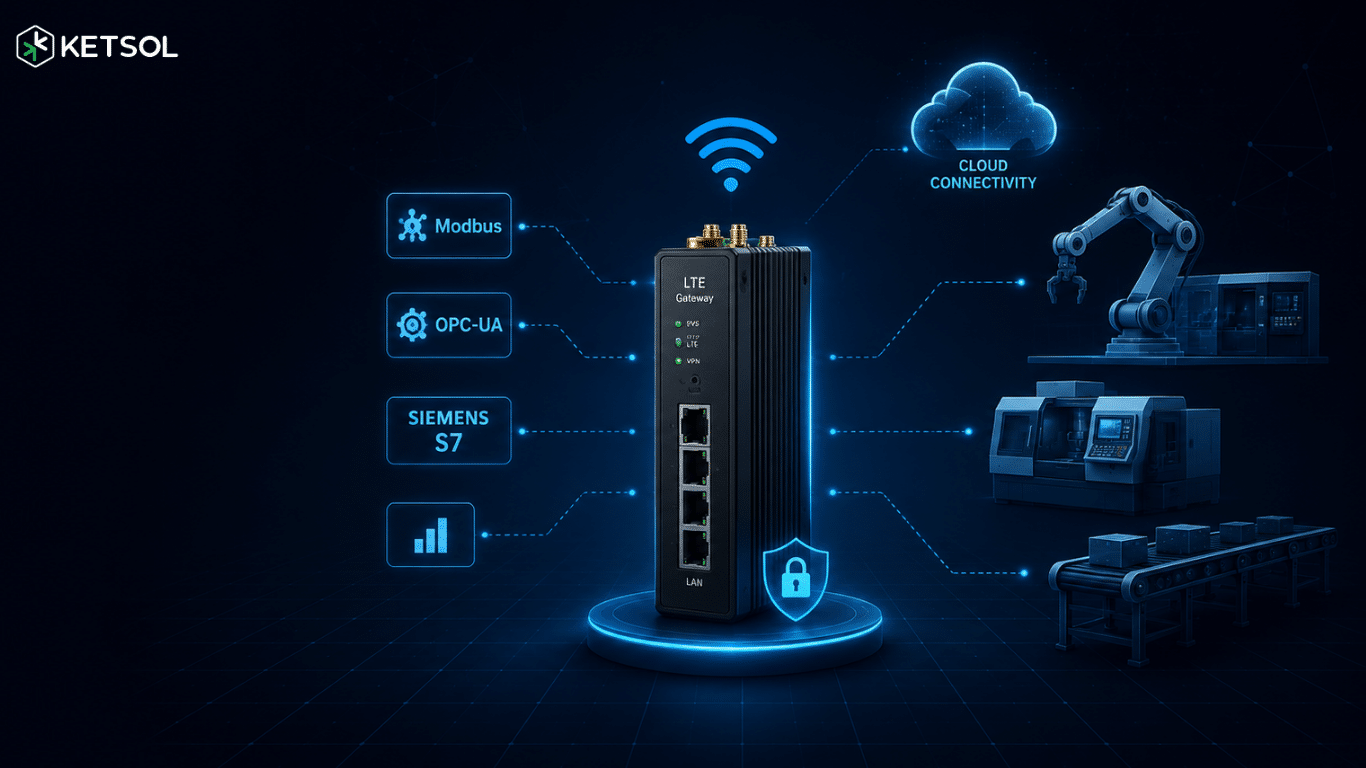
INDUSTRIAL IoT INSIGHTS
How OTA Industrial Connectivity Is Replacing Wired Infrastructure in Factory Environments
Why forward-thinking manufacturers are ditching traditional field wiring and what's replacing it.
Written by Ketsol Manufacturing Suite
Industrial Data & AI Practitioners | OT/IT Convergence Specialists.
Ketsol is an industrial technology firm specialising in data infrastructure for manufacturing environments. With over 15 years of experience across discrete and process industries, the team has delivered large-scale data architecture and IIoT implementations, including work with Tier-1 manufacturers.
Core expertise includes Unified Namespace (UNS) architecture, industrial data modelling, and AI readiness for production systems. Ketsol combines deep operational understanding with modern data engineering practices to bridge the gap between OT and enterprise systems.
Published: May 2026
Industrial facilities have a connectivity problem. Not because the technology doesn’t exist, but because the tools most teams are still using were designed for a different era, one before LTE, before cloud platforms, and before ‘remote monitoring’ meant something more than an engineer driving three hours to a substation with a laptop.
Physical cabling accounts for 30–60% of the total installation cost in brownfield deployments.
NAT configuration creates persistent firewall headaches. Firmware updates require on-site technician visits. And every new protocol — Modbus, OPC UA, Siemens S7 — often requires its own gateway hardware.
This article explores why traditional industrial connectivity is holding operations back, and how an OTA-first approach using the Teltonika RUT200/RUT906 with KMS Gateway is changing the economics of industrial IoT deployment.
Why Traditional Industrial Connectivity No Longer Makes Economic Sense
For decades, industrial connectivity meant one thing: wire everything. RS-485 bus lines for Modbus. Dedicated Ethernet runs for OPC-UA servers. Proprietary Siemens PROFINET networks.
These approaches work. They are robust and well-understood. But they come with significant operational drag:
- High upfront infrastructure cost, especially in brownfield or remote sites
- Complex NAT and VPN configuration, static IPs, port forwarding, firewall rules maintained across dozens of remote sites
- Protocol fragmentation, each protocol often requires a different gateway or middleware layer
- No remote update path, firmware and configuration changes need boots on the ground
- Slow deployment cycles, connecting a new device can take days or weeks
For a single facility, these trade-offs might be manageable. For an operation spanning 50 substations, 150 remote meters, or 40 factory lines across multiple sites, they become a significant drag on operational efficiency and IT costs.
What Is OTA Industrial Connectivity and Why Does It Matter?
OTA (Over-the-Air) industrial connectivity refers to the ability to deploy, configure, update, and secure industrial field gateways without any physical access to the device.
In practice, this means:
- Pushing new protocol configurations (Modbus register maps, OPC-UA node lists) to field devices remotely
- Rolling out firmware updates across an entire fleet simultaneously, with rollback support
- Rotating TLS certificates and encryption keys automatically before they expire
- Diagnosing device issues and changing operational parameters without sending a technician
This is not a new concept in consumer electronics. But in industrial environments — where change management is cautious, network access is restricted, and uptime is non-negotiable OTA-first architecture requires a purpose-built solution that understands industrial protocols and operational constraints.
That is where the Teltonika RUT200/RUT906 and KMS Gateway combination comes in.
Introducing the RUT + KMS Gateway Architecture
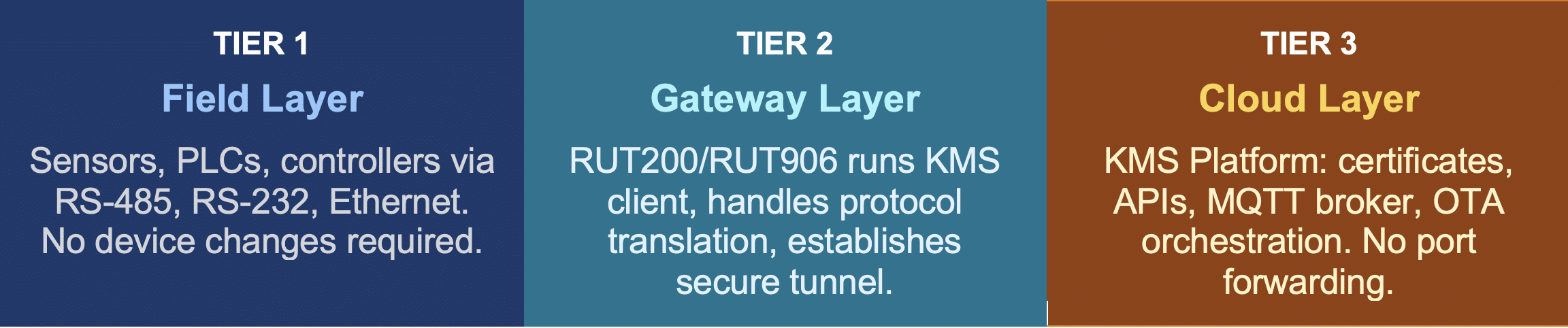
The Teltonika RUT200 and RUT906 are compact, industrial-grade LTE routers designed for harsh field environments. Paired with the KMS Gateway, a cloud-hosted connectivity and key management platform, they form a three-tier architecture.
How Does It Work Without NAT Configuration?
This is one of the architecture’s most significant practical advantages. Traditional remote access requires either a static public IP or complex NAT traversal. The KMS Gateway eliminates this through an outbound-initiated tunnel model:
- The RUT router initiates an outbound encrypted connection to the KMS endpoint
- Because the connection is outbound, no inbound firewall rules are required
- The KMS Platform routes commands and data back through the established session
- Works in NAT64, CGNAT, and carrier-grade NAT environments the reality of most LTE deployments
📄 Want the Full Technical Architecture Details? Download the complete RUT200 + KMS Gateway Technical Whitepaper to explore the full security framework, protocol specifications, and deployment architecture diagrams. |
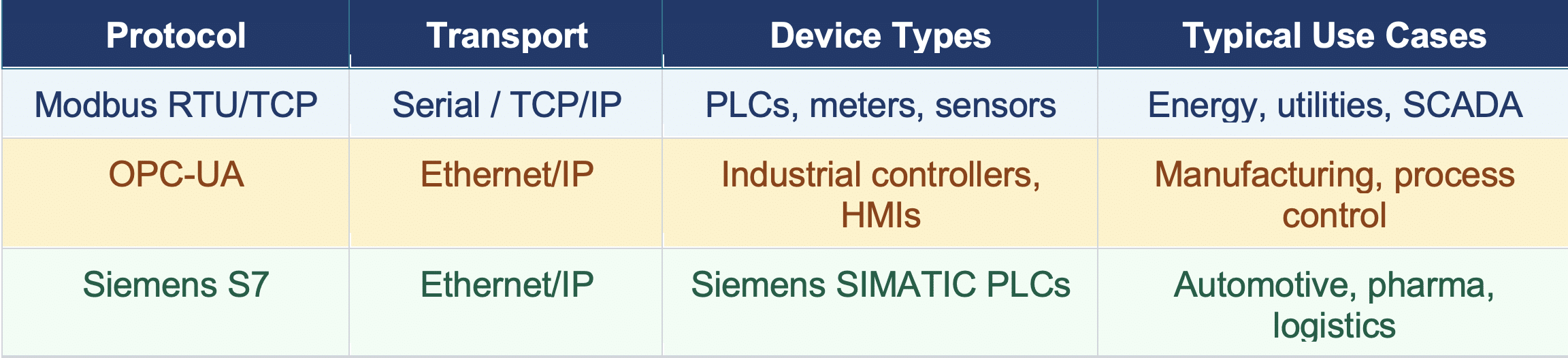
Industrial Protocol Support: Modbus, OPC-UA, and Siemens S7
How Does Modbus Work Over LTE?
Modbus is the most widely deployed industrial protocol in the world. With the RUT + KMS solution, Modbus connectivity is straightforward:
- Modbus RTU over RS-485 2-wire and 4-wire, up to 247 slave devices per bus
- Modbus TCP over Ethernet direct connection to Modbus TCP-capable devices
- Configurable polling intervals per register group, from 100ms to 24 hours
- Automatic exception code handling and retry logic
- Register map templates for 200+ common device types included out of the box
What Is OPC-UA Remote Access and Can It Be Done Securely?
OPC-UA (Unified Architecture) is the standard for secure, platform-independent data exchange in modern manufacturing. The KMS Gateway client acts as an OPC-UA client, enabling:
- Connections to OPC-UA servers on local manufacturing equipment and SCADA systems
- Both subscription (event-driven) and polling data acquisition modes
- Configurable security modes: None, Sign, or Sign and Encrypt per connection
- Certificate-based authentication with OPC-UA server certificate validation
- Node browsing and dynamic address space discovery via the KMS Platform UI
Can Siemens PLCs Connect to Cloud Platforms Without Major Modifications?
Yes, and this is one of the most common questions from OT engineers working with European manufacturing environments.
The RUT + KMS Gateway provides direct Siemens S7 protocol connectivity supporting S7-300, S7-400, S7-1200, and S7-1500 series. No modification required to the PLC program or network. Data is forwarded to cloud platforms via MQTT over the secure KMS tunnel.
OTA Capabilities: What Remote Fleet Management Actually Looks Like
Remote Configuration Management
- Push Modbus register map updates and OPC-UA node list changes remotely
- Template-based configuration for rapid deployment of identical device types
- Delta configs only changed parameters transmitted, minimising LTE data usage
- Configuration version history with point-in-time rollback capability
Firmware Updates
Roll out firmware updates to an entire fleet simultaneously. The KMS Platform handles scheduling, deployment sequencing, and automatic rollback if a device fails to update successfully.
Certificate and Key Rotation
- Automated TLS certificate renewal before expiry zero-downtime key rotation
- Full certificate lifecycle management per device
- Mutual TLS (mTLS) support for device identity verification
Store and Forward
If an LTE connection is temporarily unavailable, the RUT router buffers data locally and forwards it once connectivity is restored critical for remote deployments where connectivity is intermittent.
Traditional Setup vs. OTA Industrial Connectivity: A Direct Comparison
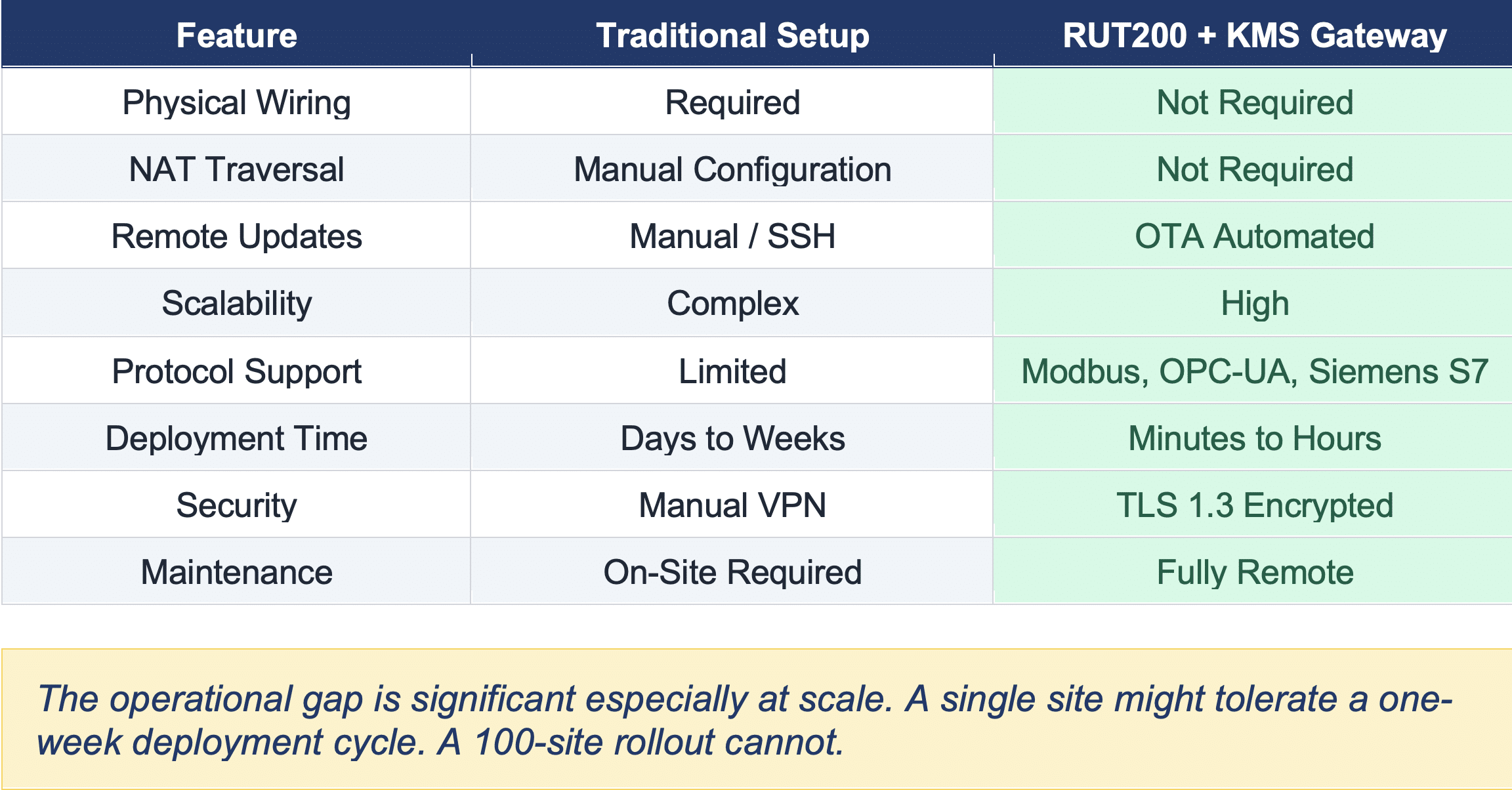
Industrial Cybersecurity: Zero Trust Without Operational Compromise
Security in industrial environments must be layered. Perimeter-based security alone is no longer sufficient as OT networks increasingly connect to IT systems and cloud platforms.
The RUT + KMS architecture implements a zero-trust security model across every layer:
- Device Identity, each RUT router carries a unique X.509 device certificate provisioned at manufacture
- Encryption, all communication uses TLS 1.3; data at rest encrypted with AES-256
- Zero Trust, every request is authenticated and authorised by the KMS Platform, regardless of network origin
- Network Segmentation, gateway maintains separation between OT (field) and IT (cloud) layers
- RBAC, operators can only access devices within their defined scope
- Full Audit Trail, every data access event, configuration change, and OTA operation is logged
Compliance Note:
Industries subject to IEC 62443, NERC CIP, or NIS2 requirements will find the KMS architecture directly relevant to their compliance posture.
🔒 Ready to Evaluate the Security Architecture?
The full whitepaper includes a complete breakdown of the KMS security framework, certificate lifecycle management, and compliance considerations.
Real-World Use Cases: Where This Architecture Delivers Results
Remote Substation Monitoring Energy & Utilities
Challenge: Monitor 150 remote substations using Modbus RTU energy meters. Fiber/DSL cost-prohibitive for many locations.
Solution: One RUT200 per substation on existing RS-485 bus. LTE uplink. KMS aggregates data securely to utility SCADA.
Outcome: OTA updates rolled out new meter register maps without any field visits.
Manufacturing Line Integration Automotive Tier-1 Supplier
Challenge: Connect 40 Siemens S7-1500 PLCs to a cloud MES without modifying the existing production network.
Solution: RUT200 per PLC via Ethernet on separate VLAN. KMS reads production counters and alarms via S7 protocol, forwards to cloud MES via MQTT.
Outcome: Full fleet managed from KMS Platform without production interruption.
OPC-UA SCADA Remote Access Water Treatment Facility
Challenge: Secure remote access to OPC-UA SCADA for operations staff and third-party maintenance contractors.
Solution: Single RUT200 at the facility. KMS exposes controlled OPC-UA nodes. RBAC enforced at the KMS layer no OPC UA server changes.
Outcome: Contractor access granted with time-limited certificates that expired automatically.
These use cases mirror deployments Ketsol has already done on real plants see how customers are running KMS in production →
Frequently Asked Questions
- What is OTA in Industrial IoT?
OTA (Over-the-Air) in industrial IoT refers to the ability to remotely deploy, configure, update, and secure industrial gateway devices without physical access. This includes firmware updates, protocol configuration changes, certificate rotation, and remote diagnostics — managed from a central cloud platform.
2. How do you remotely monitor PLCs without a VPN?
The RUT200 + KMS Gateway uses an outbound-initiated encrypted tunnel. The field gateway connects to the cloud platform, eliminating the need for inbound firewall rules, static IP addresses, or VPN concentrators.
3. Can Modbus devices send data over LTE?
Yes. The RUT200 connects to Modbus RTU devices over RS-485 or Modbus TCP devices over Ethernet. Data is transmitted over LTE to the KMS Gateway and forwarded to SCADA, MES, or cloud analytics platforms. No static IP address is required.
4. Is it possible to connect Siemens PLCs to cloud platforms without modifying them?
Yes. The KMS Gateway client supports the native Siemens S7 protocol (S7-300, S7-400, S7-1200, S7-1500). No modification to the PLC program or network is required. Data is read via S7 TCP and forwarded to cloud platforms via MQTT over the secure KMS tunnel.
5. What industrial cybersecurity standards does this architecture support?
The RUT + KMS architecture uses TLS 1.3 encryption, X.509 device certificates, mutual TLS authentication, zero-trust access control, and RBAC with least-privilege principles. These align with IEC 62443, NERC CIP, and NIS2 framework requirements.
The Future of Industrial Connectivity Is Wireless, Managed, and Secure
The industrial automation sector is at an inflexion point. The cost of deploying and maintaining wired infrastructure in greenfield and brownfield sites alike is increasingly difficult to justify when wireless, cloud-managed alternatives deliver equivalent or superior reliability.
The combination of proven industrial hardware (Teltonika RUT200/RUT906), cloud-native OTA management (KMS Gateway), and comprehensive protocol support (Modbus, OPC-UA, Siemens S7) represents a credible, production-ready path toward that future.
The transition to Industry 4.0 doesn’t require a greenfield rebuild. It often starts with a single cellular router and a cloud management platform and grows from there.
📥 Get the Full Technical Whitepaper
Explore the complete architecture breakdown, security framework, protocol specifications, and real-world deployment case studies.
[ Request the Whitepaper Now → ]
Available at no cost. No commitment required.
Published May 2026 | Industrial IoT | Remote Connectivity | Industry 4.0 | OTA Gateway