Andon System in Manufacturing India:
Beyond Alerts
Written by Ketsol Manufacturing Suite
Industrial Data & AI Practitioners | OT/IT Convergence Specialists.
Ketsol is an industrial technology firm specialising in data infrastructure for manufacturing environments. With over 15 years of experience across discrete and process industries, the team has delivered large-scale data architecture and IIoT implementations, including work with Tier-1 manufacturers.
Core expertise includes Unified Namespace (UNS) architecture, industrial data modelling, and AI readiness for production systems. Ketsol combines deep operational understanding with modern data engineering practices to bridge the gap between OT and enterprise systems.
Published: Jun 2026
Most factories in India already have alerts. Buzzers, signal lights, SMS notifications, the infrastructure exists. And yet, production lines still lose hours to problems that should have been solved in minutes.
The issue isn’t the absence of an alert. It’s what happens after the alert fires.
An Andon system, done right, doesn’t just notify it triggers action. This is the distinction that separates factories that recover fast from those that spend their shifts firefighting.
In this article, we break down what an Andon system actually is, why Indian manufacturers are paying closer attention to it now, and what to look for when evaluating one.
What Is an Andon System in Manufacturing?
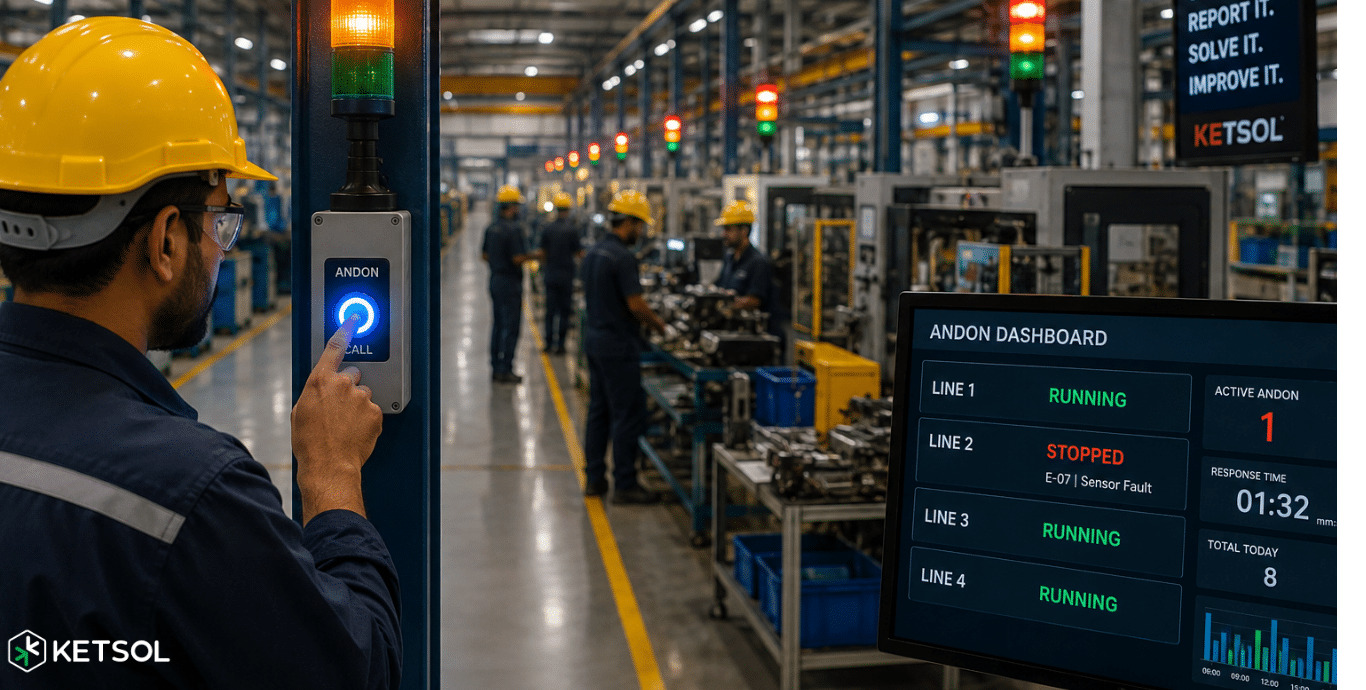
Andon is a Japanese term meaning ‘signal’ or ‘lamp.’ In lean manufacturing, it refers to a visual management system that communicates the status of a production line in real time.
At its core, an Andon system does three things:
- Detects an abnormal condition: a quality issue, machine fault, or process delay
- Signals the right people immediately: operator, supervisor, maintenance team
- Enables a fast, structured response: stop, fix, resume
Traditional Andon systems used physical signal towers with colour-coded lights: green (running), yellow (caution), red (stopped). Modern systems layer digital alerts, dashboards, and IoT connectivity on top of that foundation.
Key distinction:
An alert tells you something is wrong. An Andon system tells you what is wrong, where, and who needs to act, within seconds.
Why Are Indian Manufacturers Adopting Andon Now?
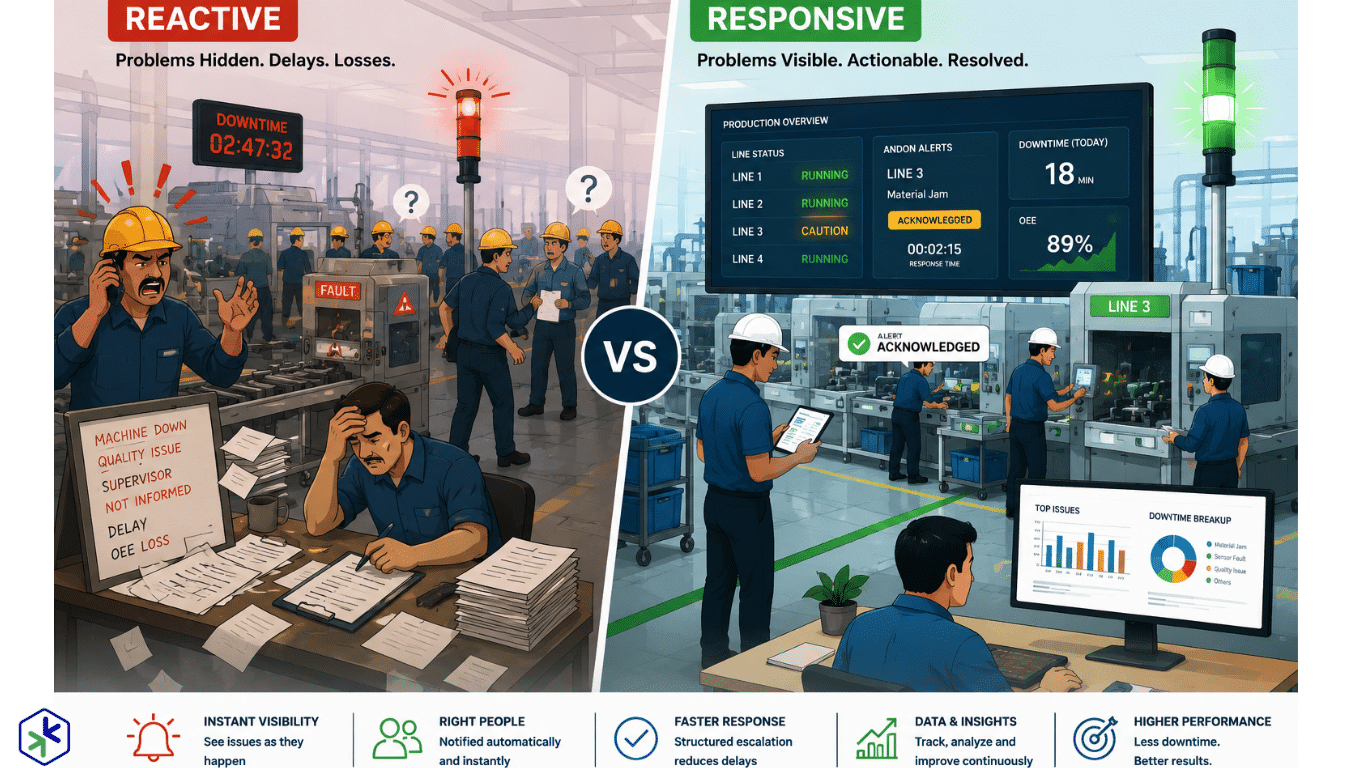
India’s manufacturing sector is under pressure on two fronts: rising customer expectations for quality, and tighter timelines driven by global supply chain demands. Both expose a fundamental gap; most plants react to problems, rather than respond to them.
Several factors are accelerating Andon adoption across Indian factories:
- Export mandates: Automotive and electronics OEMs increasingly require documented downtime management as part of supplier qualification
- Workforce variability: High operator turnover on the floor means knowledge can’t live in someone’s head, it needs to be in the system
- Cost of downtime: In high-volume production, even 15 minutes of unplanned stoppage can cost ₹2–5 lakhs, depending on the line
- PLI scheme pressure: Factories scaling under India’s Production Linked Incentive scheme need operational infrastructure to match output targets
The shift isn’t about adopting technology for its own sake. It’s about building a floor where problems surface fast and get resolved faster.
Why Alerts Alone Don't Solve Production Problems
This is the part most vendors won’t tell you.
A notification system sends a message. A supervisor sees it on their phone, maybe while in a meeting, maybe after 4 minutes, maybe not at all. By the time someone physically reaches the station, the damage is done.
Alerts fail for three predictable reasons:
- No escalation logic: If the first responder doesn’t act, nobody else is triggered automatically
- No context at the point of action: The operator gets an alert but not the reason, the history, or the fix
- No feedback loop: There’s no record of how long it took to respond, or whether the same problem has happened before
An effective Andon system closes these gaps. It doesn’t just alert it escalates, contextualises, and records.
From the floor
Plants that implement structured Andon response protocols, not just lights and buzzers , typically reduce mean time to respond (MTTR) by 30–60% within the first quarter.
What Should a Modern Andon System Include?
If you’re evaluating an Andon solution for your plant, these are the components that matter:
- Real-Time Signal Capture
Andon inputs should come from multiple sources: physical call buttons on the line, machine OPC-UA or MQTT signals, sensor triggers, or manual operator input. The system should capture the signal within seconds — not on a polling cycle.
- Escalation Workflows
Define who gets notified first, and who gets pulled in if there’s no response within a set time. This removes dependence on individual awareness.
- Status Visibility Across the Floor
Physical signal towers still matter — they give everyone on the floor instant line-of-sight awareness. Digital dashboards extend this to supervisors and management in control rooms or remote locations.
- Response Logging and Analytics
Every Andon event should be timestamped and tracked: when it was raised, when it was acknowledged, when it was resolved. This data powers downtime analysis, identifies repeat failures, and supports continuous improvement.
- Integration With Existing Plant Systems
A standalone Andon system creates another data silo. The best implementations connect to SCADA, MES, or ERP systems so production data flows in one place.
The KMS Gateway connects Andon signal sources to plant-level systems via OPC UA, MQTT, and SQL without replacing existing infrastructure. See how it works on the KMS Gateway product page.
How to Implement an Andon System in Factory
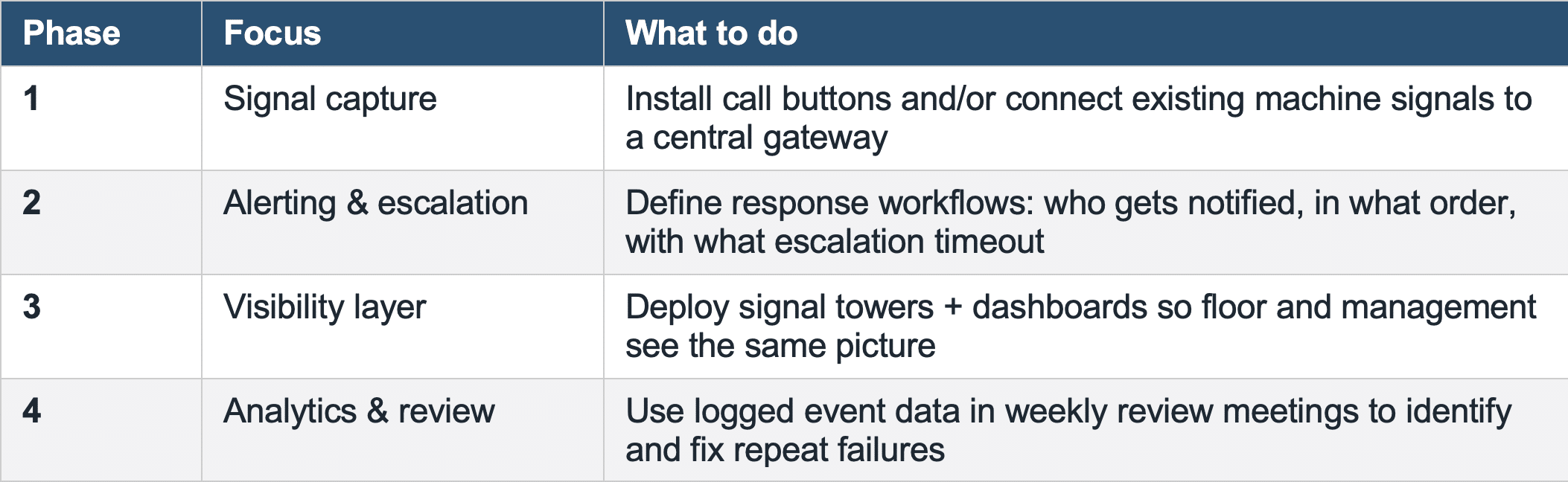
Implementation doesn’t have to be a large-scale project. A phased approach works well for most plants:
Real-World Context: Tank Farm Monitoring and Andon Principles
The same principles that make Andon effective on a production line apply to process industries like tank farm operations. When a level sensor breaches a threshold, the question isn’t just ‘did the alert fire?’ it’s ‘who responded, how fast, and what did they do?’
Ketsol’s tank farm monitoring solutions apply this structured-response model to fluid storage and process environments, where undetected overflows or pressure anomalies carry significant safety and compliance risk.
See also
Explore how Ketsol applies real-time monitoring and response workflows to industrial environments visit ketsol.ai/use-cases for live deployment examples.
The Bottom Line
An Andon system is not a notification upgrade. It’s a production philosophy where problems are surfaced immediately, routed to the right person, and resolved with a record that feeds future improvement.
For Indian manufacturers navigating quality pressures, export requirements, and scale targets, Andon is one of the highest-leverage investments available.
The question isn’t whether to implement it. It’s whether your current setup is built to act on signals or just receive them.
If you’re evaluating Andon implementation for your plant, the architecture of your connectivity layer matters as much as the alerts themselves. See how the KMS Gateway handles signal collection and routing from mixed-protocol environments without replacing what you’ve already built.
Frequently Asked Questions:
- What is an Andon system in manufacturing?
An Andon system is a visual management tool used on production lines to signal abnormal conditions such as machine faults, quality issues, or process delays in real time. It enables fast, structured responses rather than delayed reactions.
- Why don’t alerts alone solve production problems?
Alerts notify, but they don’t escalate, contextualise, or record. Without a defined response workflow, alerts get missed, delayed, or ignored and the root cause remains unresolved.
- How does an Andon system reduce downtime?
By triggering an immediate, targeted response to production abnormalities with escalation logic if the first responder doesn’t act, Andon systems reduce mean time to respond (MTTR) and prevent short stoppages from becoming long ones.
- Is an Andon system suitable for Indian factories?
Yes. Modern Andon systems can integrate with existing PLC, SCADA, and ERP infrastructure using standard protocols like OPC UA and MQTT, making them viable for both greenfield plants and legacy environments common in India.
- How long does Andon implementation take?
A phased implementation, starting with signal capture and alerting, can go live in 4–8 weeks for a single production line. Full analytics integration typically follows in a second phase.
- What’s the difference between an Andon system and a SCADA system?
SCADA monitors and controls processes across an entire facility. An Andon system is specifically focused on production floor visibility and response; it’s operator-facing, real-time, and action-oriented. The two are complementary, not competing.
Published Jun 2026 | Industrial Automation| IIoT Solutions | Industry 4.0 | KMS Gateway | Andon System in Indian Manufacturing